![[Unit 5 Tips] – Moving around in Japan](https://www.easyjapanesee.com/wp-content/uploads/2023/02/IMG_5771-scaled.jpg)
Getting to the city from the airport
Most major airports are served by a train line or two as well as airport buses. They are well sign posted in English.
Tickets for trains and buses can be purchased on a ticket machine, which can display instructions in English.
You can use taxis too but they are usually a lot more expensive. Having said that, if you are travelling to the city centre of Kyoto from Kansai or Osaka (Itami) International Airport, you can pre-book an Airport Transfer service run by MK Taxi for a flat rate to any address within a prescribed area. I find this is the most economical option when I go to Kyoto. The driver helps you with the luggage too, so I highly recommend this service. If you are in a large group, you can hire a people mover with a driver with them too.
Train Travel in Japan
Japan has a most extensive train network throughout the country. Trains usually run on-time and are generally very clean.
However, one of the most confusing things about train travels in Japan is that there are so many different train service providers and each provider has different fare rules.
JR (Japan Railway) networks
The biggest train networks in Japan are JR’s. They are now divided into the following 6 groups but they used to form one gigantic network called Japan National Railways and they provide seamless long-distance journeys throughout Japan, sharing tracks with each other.
All JR stations are marked with this logo though the colour will be different.

Almost all JR stations have their name written in English alphabet. Also most trains announce their stops in English. So trips using JR networks are quite easy.
Many long-distance trains including Shinkansen (bullet train) have vending machines or a canteen inside where you can purchase drinks and snacks. Some trains have a wagon service with some packed lunches and souvenirs.
Other Networks
JR networks connect cities and towns very well but often JR stations are located at the edge of a city/town and people need to use buses, subways, trams and/or other smaller train networks to get to the destination within the city/town.
The Tokyo Metropolitan area has as many as 10 train/subway networks other than JR and all big cities have a few each.
Some of these networks are operated by their respective local government and others are run by private companies.
If a station does not display the JR logo shown above, that station and its tracks do NOT belong to JR and you will need to pay their fare to get in even if you have a JR pass.
Pros and Cons of JR passes
Even though JR tickets sold in Japan are quite expensive, if you buy a JR pass before you go to Japan (you can buy it after you arrive in Japan, too, but it will be slightly more expensive), you can enjoy almost unlimited travel within the entire JR networks for 7, 14 or 21 days at a heavily discounted price – that is: a 7 day pass costs less than purchasing a return bullet train ticket between Tokyo and Hiroshima in Japan. Also, if you use the pass, you don’t have to worry about ticket rules, etc. so, it is easier.
However, as I mentioned before, JR is not the only train networks around big cities like Tokyo and Osaka, and these other networks do not accept JR passes. If you are only staying within a smaller area around a big city or two, probably it’s not worth getting a JR pass.
All of the above 6 JR networks as well as other private railway networks also offer a pass or more within (a part of) their own network, although some are seasonal and not available at all times. If you are visiting a smaller area only, it will be worth while checking what is available at the time of your visit.
Traffic IC cards – Suica, Pasmo, Icoca, Toica, etc.
If you are moving around using public transport in or around a big city, it is almost inevitable for you to use multiple means of transport across different networks. You can purchase a separate ticket on a ticket machine or pay the fare each time you use a different network, but if you purchase a traffic IC card such as Suica, Pasmo (both sold in the Tokyo area) or Icoca (sold in the Kansai area), you don’t have to pay each time. These are rechargeable, contact-less cards and you can tap the card at the gate of a train station and/or the fare machine on a bus and the correct fare will be deducted from the balance on the card automatically. This is particularly convenient within or around a big city because urban and suburban trains often share a track, so you may be using multiple networks on a single train journey without you noticing it. If this is the case and if you don’t use an IC card, you will not be able to get out of the destination station until you pay the adjustment fare on a fare adjustment machine or in person.
Although the choice of cards you can get is limited by the place of your purchase, most of them work nation-wide and most of them can also be used as electronic money, i.e. you can often purchase items in a shop with the balance left on the card even if the shop does not take credit cards. Each card has different coverage and rules about recharging but you can usually recharge them on a machine located in a train station. You may also be able to recharge online using a credit card. Many of them offer discounts on certain things and/or award points which can be exchanged with goods, so check the merits and demerits before you decide which one to purchase. You can get some information in English if you Google any of the cards mentioned above. Some travel agencies in your country may sell pre-charged cards in your country, but you can buy them readily at most train stations in Japan. As an IC card cannot be shared between people for the same trip, you will need to purchase one card for each fare paying person in your group. Children’s IC cards are sold only in Japan.
If you have an iPhone, you can download Suica app and they say it works the same as a physical card but people’s reviews on the app are not generally that great.
Note that an IC card is NOT a direct alternative to a JR pass. Many travellers use both and remember: if you have an IC card as well as a JR pass, don’t use the IC card at a JR gate!
Classifications of Trains
Some trains are faster than others because they stop less frequently. If you are traveling on suburban trains (JR or others), it may be useful to note that they have the following types of trains and they are often colour coded.
普通 (Futsuu/Local): These trains stop at every station on their line. Some local trains may be indicated on signboards as 各駅停車 (kakuekiteisha/”this train stops at every station”) as well.
準急 (Junkyuu/Semi-Express, Local Express): These trains stop at fewer stations than local trains (thus a bit faster), but make more frequent stops than Rapid trains explained below.
快速 (Kaisoku/Rapid): These trains stop at fewer stations than semi-express trains, but, with a few exceptions, they make more frequent stops than New Rapid or Express trains explained below.
新快速 (Shin_Kaisoku/New Rapid) or 特快速 (Tok_Kaisoku/Special Rapid): These trains stop at fewer stations than Rapid trains, but, with a few exceptions, they make more frequent stops than Express trains explained below. You do not need to pay any extra to use any of the above 4 services.
急行 (Kyuukou/Express): These trains stop at fewer stations than New/Special Rapid or Rapid trains, and typically run more frequently than limited express trains described below. In some networks including JR, you will have to pay extra to use these services unless you have an appropriate pass.
特急 (Tokkyuu/Limited Express): As noted above, this train stops at the fewest stations. In most networks including JR, you will have to pay extra to use these services unless you have an appropriate pass. All shinkansen (bullet train) services are considered to be Limited Express.
If you have to pay extra for using an express train, you can usually use your balance on your IC card, but depending on the network, it may not be deducted automatically – i.e. you may need to purchase a separate express ticket (for which you can use the balance of the IC card if you so wish).
Most stations will have a diagram like this which shows you what kind of trains stop where:
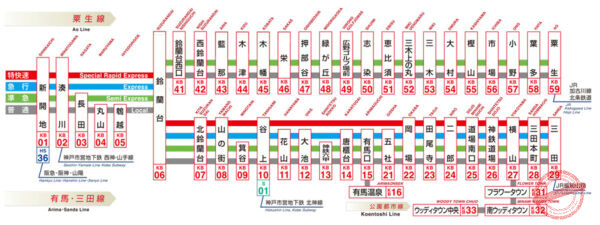
If you ask somebody near this sign: “xxx ni tomarimasuka?” (= Does this stop at xxx?), somebody will be able to help you if you know the name of the stop you want to get off at.
Travelling with a suitcase on Shinkansen (Bullet Train)
If you are travelling with a big suitcase (the sum of length + width + height is over 160 cm), you need to book a seat with an extra space, which is located at the back of each car. These seats are sold for the same price as other seats but because the number is limited, you should make the booking ASAP. If you bring a big suitcase without booking one of these seats, you will be asked to pay extra for the luggage. This rule also applies for a pram/stroller and/or a bicycle. They say smaller suitcases will fit in the overhead luggage space.
I usually send big suitcases by courier (takkyuubin) to my destination so that I don’t have to struggle with them. You can do this from any convenient stores.
Other Hints about Train Travel
I received the following feedback from somebody who subscribed to this course before going to Japan:
- People are quiet on trains, no mobile phones!
- Perhaps also check that it isn’t a women-only carriage as, in some suburban networks, there may be a carriage or two for female passengers (and their young child(ren)) only. If it is “women only”, the cars will be marked with 女性専用 (josei_senyou) and the sign is usually pink (not always).
Buses
Where trains don’t run, there are buses. Most short-distance buses accept most traffic IC cards readily. You tap the card and the fare will be deducted automatically. Alternatively you can pay the exact amount with coins – not many buses carry any change.
There are also many long-distance buses between major cities. Some run at night, so you can save on a night’s accommodation. You may be able to get onboard without a pre-booking but booking is recommended. Most long-distance buses won’t accept IC-cards onboard, so you will need to purchase a ticket, for which you may be able to use the balance of your IC card (if you have one).
Also, places where many English-speaking people visit, like Kyoto, there are many bus tours conducted in English. These are limited in some ways but it is a good way to get to go to places which are not easily accessible.
Children’s fare on Public Transport
Although it is not completely universal, children between 6 and 12 years (kodomo
Taxi and Uber
Taxis operate throughout Japan. Taxi fares are calculated by the distance travelled and the time taken (it could be costly in a traffic jam) and they may have surcharges for reservations and/or late night travels, etc.
A limited number of cities allow Uber to operate but Uber services in Japan are run by taxi companies and considered as a hire car service, thus it is generally more expensive than using an ordinary taxi.
Car Hire
You can hire a car and drive yourself. In Japan they drive on the left side of the road. Travellers from Australia, NZ and UK will find it easier to drive there than in Europe!
On express ways, the maximum speed limit is 100 km/h and the minimum speed limit is 50km/h unless otherwise stated.
If you think you may do that, make sure you take your official International Driver License with you! Be aware of Internet sites which try to sell you a fake one!